
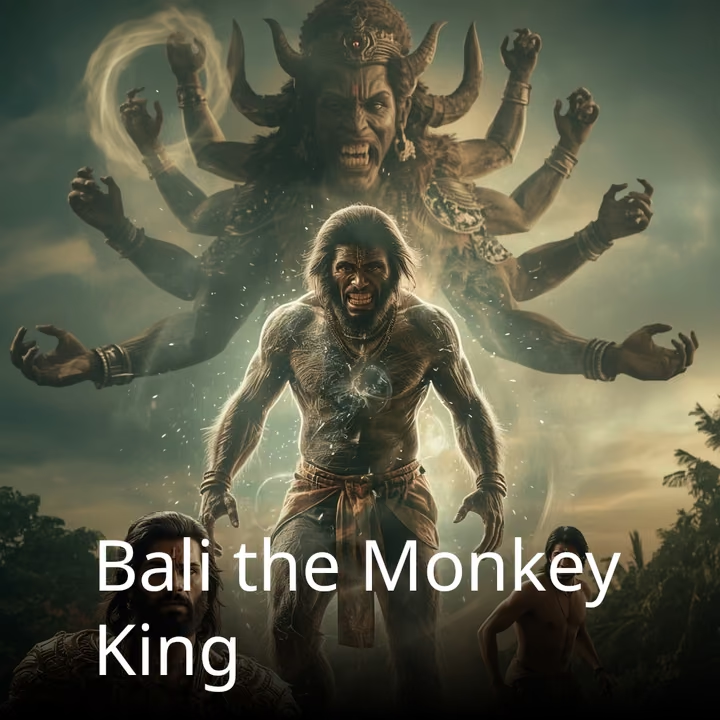
Bali the Monkey King
"The Echo of the Unconquered" Thematic Essence: This is a story of aftermath,resonance, and psychological siege. It explores the vacuum left by a titan’s fall, not through battle, but through cunning....
"The Echo of the Unconquered" Thematic Essence: This is a story of aftermath,resonance, and psychological siege. It explores the vacuum left by a titan’s fall, not through battle, but through cunning containment. The narrative shifts from physical might to the more subtle warfare of spirit, memory, and karma. It’s a tale about how a kingdom’s soul survives when its sun is eclipsed, and how true strength is rediscovered not in defiance alone, but in reconnection to one’s foundational essence. Central Imagery & Atmosphere: 1. The Hollow Throne: Kishkindha is depicted in a state of profound psychic winter. The grandeur of the grown palace remains, but it feels empty, its warmth gone. The silence is a tangible presence—not peaceful, but aching with the absence of Bali’s golden hum. The throne is no longer a seat of power but a monument to loss, cold and forbidding to the usurper-brother who must occupy it. 2. The Grey Prison: The cage on the plains of Rishyamukha is the story’s central, haunting symbol. It is not a dungeon of iron, but a shimmering, opaque dome of solidified shadow and misapplied spiritual energy. It doesn’t crush; it nullifies. It is a blister on the landscape, a perpetual, silent scream mocking the concept of victory. It represents Ravana’s victory of intellect over brute force, a perversion of devotion into a weapon of psychological torture for an entire kingdom. 3. The Contrast of Realms: · Kishkindha: Once vibrant and organic, now muted. Colors are described as dulled (Angada’s fur), light is feeble, and sounds are hollow echoes. It operates on fear, uncertainty, and fractured loyalty. · Lanka: Presented through Hanuman’s eyes as a place of cold, polished magnificence and implicit cruelty. Its beauty is severe, its logic tyrannical. The mother-of-pearl message embodies this—fragile beauty containing brutal ultimatums. · The Mystical Sites: The Well of Silence is a place of terrifying, absolute quiet and petrified ambition, where power is accrued through supreme self-denial. The Cavern of the Heart’s Touch beneath Kishkindha is its antithesis: warm, humming, humble, operating on the principles of connection and empathy. Character Dynamics & Inner Landscapes: · Sugriva (The Steward): His internal world is a maze of guilt, inadequacy, and strategic despair. He moves from paralysis to a desperate, clever resolve. He embodies the "shadow-king," learning to fight with tools Bali never needed: deception, patience, and intellectual reconnaissance. His arc is from a brother living in a sun’s shadow to a leader who must learn to cast his own light, however faint. · Bali (The Captive Sun): His imprisonment is psychological and spiritual. The grey dome is a sensory deprivation chamber for the soul. His journey inside is from raging against the walls to a bleak, timeless stasis, and finally to an awakening triggered not by external force, but by the resonant echo of love and duty. His power transforms from an external, syphoning force (the pearl) to an internal, generative one. · Ravana (The Architect): He is portrayed less as a monster and more as the ultimate cosmic lawyer and scholar-tyrant. His power is in contracts, loopholes, and the meticulous application of accumulated spiritual capital. His fury at Bali’s escape is the rage of a genius who sees his perfect equation disrupted by a variable he considered sentimental and therefore negligible. · The Supporting Ensemble: · Hanuman: The emerging scholar-spy, his strength is his curious mind and linguistic skill, prefiguring his future role. · Chaya: A being of mist and debt, representing the older, subtler magic of bonds and obligations that exists outside the binary of strength vs. cunning. · Angada & Tara: Represent the personal, emotional heart of the crisis—a son’s simmering fury and a wife’s steely, grieving wisdom. Narrative Mechanics & Style: The prose aims for a mythic,sensory-rich quality. It uses: writer Parmod Kumar Prajapati..........