
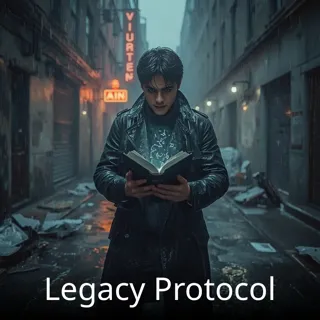
Legacy Protocol
In a near-future city dominated by corporate influence and rigid social hierarchies, seventeen-year-old Kai is an ordinary, overlooked member of a once-powerful family whose fortune has dwindled under the weight....
In a near-future city dominated by corporate influence and rigid social hierarchies, seventeen-year-old Kai is an ordinary, overlooked member of a once-powerful family whose fortune has dwindled under the weight of its own reputation. When his estranged grandfather dies under mysterious circumstances, Kai receives a sealed black book instead of the inheritance everyone else expects—no money, no connections, only a cryptic system that claims to grant power, under one simple condition: everything has a cost. The book, sent from beyond the grave, is not a gift but a test, designed to challenge Kai’s morality, endurance, and identity. Kai’s first encounter with the book is immediate and brutal. A collapsed transport drone traps a man in the street below his apartment. The book offers activation: a surge of power capable of saving the man, but in return, it will take something from Kai permanently. Choosing to act, Kai experiences the first cost—a memory from his childhood erased, a part of himself irreversibly gone. The victory is hollow, the thrill of power immediately shadowed by loss. This sets the tone for the series: every gain is paired with sacrifice, every action is morally weighted, and consequences are unavoidable. As episodes unfold, Kai navigates increasingly complex scenarios. Each activation demands decisions that pit his immediate survival or the welfare of others against his humanity. In one episode, he can save a friend by taking power from someone else’s life, forcing him to reckon with the guilt of indirect harm. In another, he’s tempted to manipulate the system for personal gain, only to discover the book punishes such selfishness in ways that ripple beyond the immediate moment. The system is not just a tool—it’s an ethical pressure cooker, shaping him as much as he shapes it, forcing choices that reveal the truth about his character. The series delves into family legacy as a source of tension. Kai’s grandfather is never presented as benevolent; the book, like its creator, is manipulative and cruel, leaving behind riddles and traps instead of guidance. Each interaction forces Kai to confront the shadow of the family he never wanted to emulate. The narrative explores the corrosive nature of inherited privilege and responsibility, asking whether one can inherit wealth, power, or even guidance without also inheriting guilt and mistakes. The protagonist’s growth is measured not in strength, but in his ability to navigate these moral quandaries without losing himself entirely. “Legacy Protocol” also examines broader societal pressures. The city itself, advanced but morally ambiguous, mirrors Kai’s inner struggles. Wealth, status, and power are currency, but the system exposes the hollowness of ambition when it comes at the expense of integrity. Each episode is a microcosm of this tension: what is worth gaining if it costs your soul, or erases part of who you were? Consequences are immediate, personal, and permanent, and failure is not excused. The stakes are psychological, ethical, and emotional, as well as physical, creating tension that extends beyond simple action or spectacle. The episodic structure is deliberate. Each episode functions as a self-contained moral test while contributing to the larger arc: Kai’s gradual understanding of the system, the hidden motives of his grandfather, and the ultimate realization that power alone cannot resolve inherited problems. By the final episodes, the protagonist is faced with the ultimate choice: surrender to the system and secure survival and power at tremendous cost, or reject it and accept personal vulnerability while striving to repair some part of the damage caused by his family’s legacy. The story leaves the audience questioning: what does it truly mean to inherit a legacy, and how much of yourself are you willing to sacrifice to survive it? “Legacy Protocol” is an exploration of morality in a hyper-competitive, technologically advanced society. It combines the tens
Disclaimer: This show may contain expletives, strong language, and mature content for adult listeners, including sexually explicit content and themes of violence. This is a work of fiction and any resemblance to real persons, businesses, places or events is coincidental. This show is not intended to offend or defame any individual, entity, caste, community, race, religion or to denigrate any institution or person, living or dead. Listener's discretion is advised.